Executive summary
As generative AI made convincing synthetic media easy to create, familiar trust signals began to break down. Labels and fact-checking could not scale, and poorly framed disclosures often made people trust less, not more.
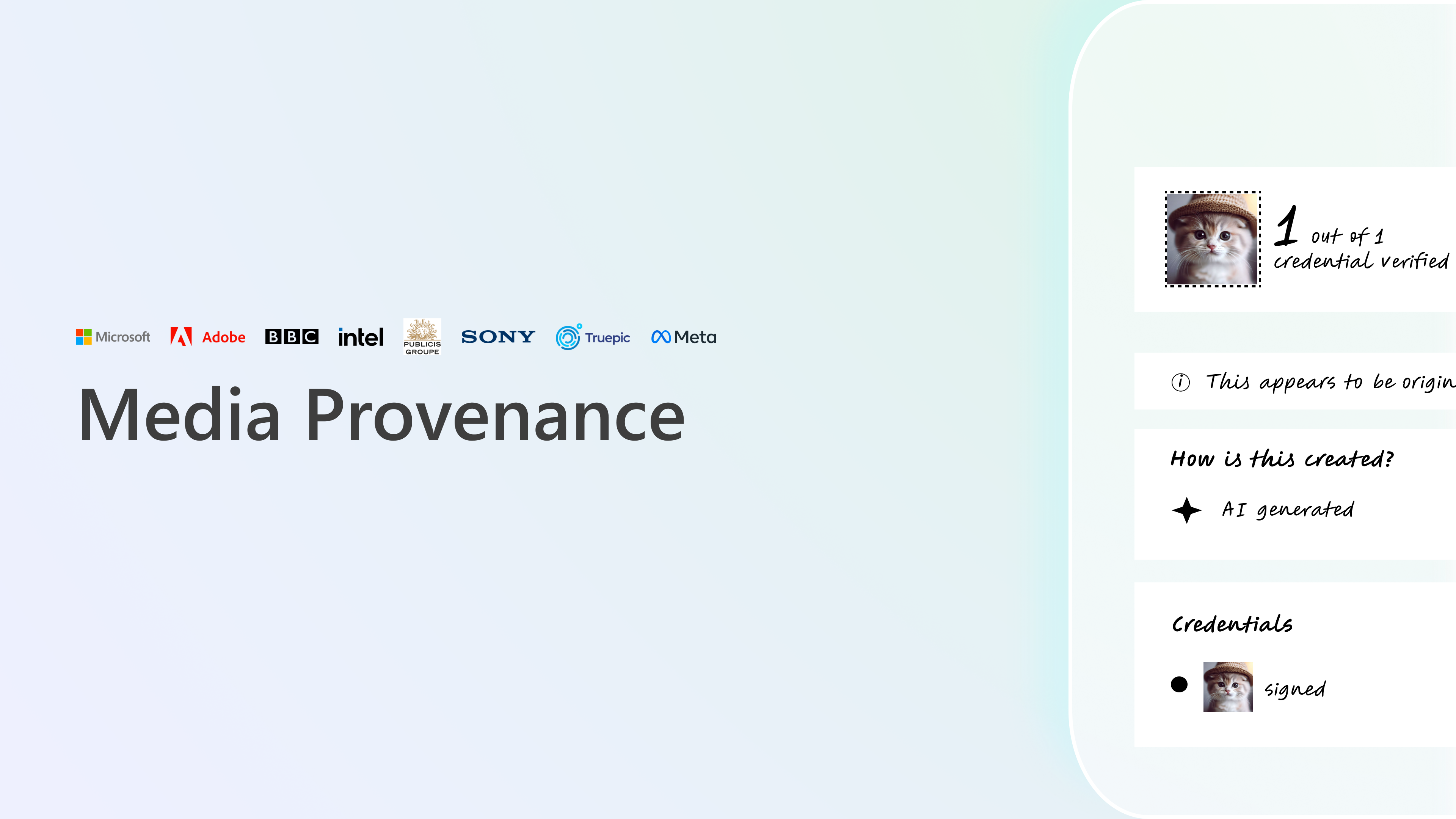
I led UX strategy for Microsoft’s Content Provenance & Authenticity Initiative, managing a five-person UX team and aligning product, engineering, Legal, Responsible AI, and external partners around a scalable trust model. Together, we translated the emerging C2PA industry standard into a product system that helps people understand what is known, unknown, or compromised without declaring whether content is true.
The pivotal decision was replacing “Verified” with “Certified.” I made the final terminology decision after research and partner review showed that “Verified” implied Microsoft endorsed the content as true. “Certified” described the presence and integrity of its provenance record, not the truth of the content itself. That distinction aligned product, Legal, Responsible AI, and industry partners around a neutral model that could scale.
The resulting system shipped across Bing, Designer, Edge, and LinkedIn. Across three iterative studies with 22 participants, research supported the shift from “Verified” to “Certified,” the need for neutral language and progressive disclosure, and explicit handling of incomplete or compromised credentials. After launch, the verification portal recorded 5,000+ verification events in its first month.
Stakes
How do you help people identify AI-manipulated or synthetic content without making them distrust everything?
Cryptographic provenance is technically complex, easy to misunderstand, and risky to oversimplify. A signal must communicate what happened to a piece of content while remaining useful when credentials are incomplete, invalid, or deliberately compromised.
The obvious language created its own risk. “Verified” could imply endorsement or absolute truth. Blunt AI labels could trigger excessive skepticism. Missing data could be mistaken for evidence of deception. A poorly designed system could produce panic, blind trust, or disengagement and undermine informed judgment.
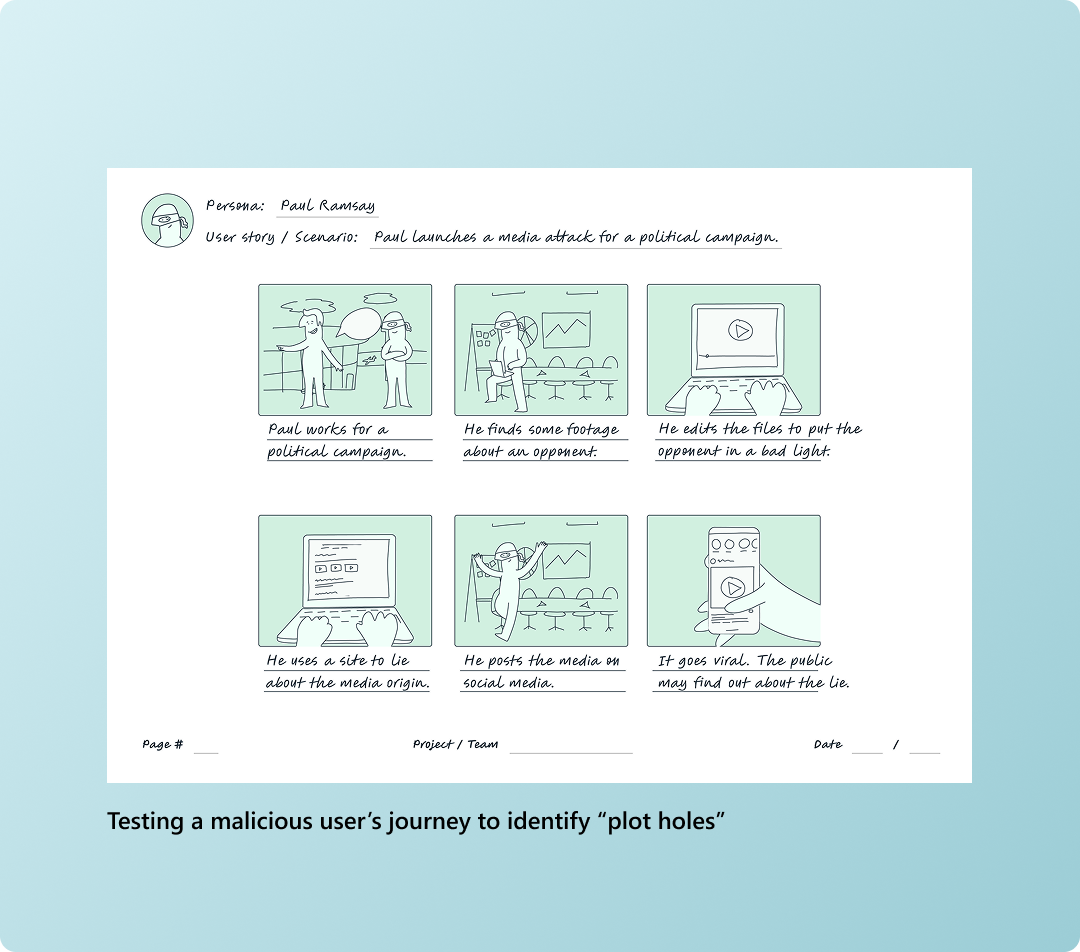
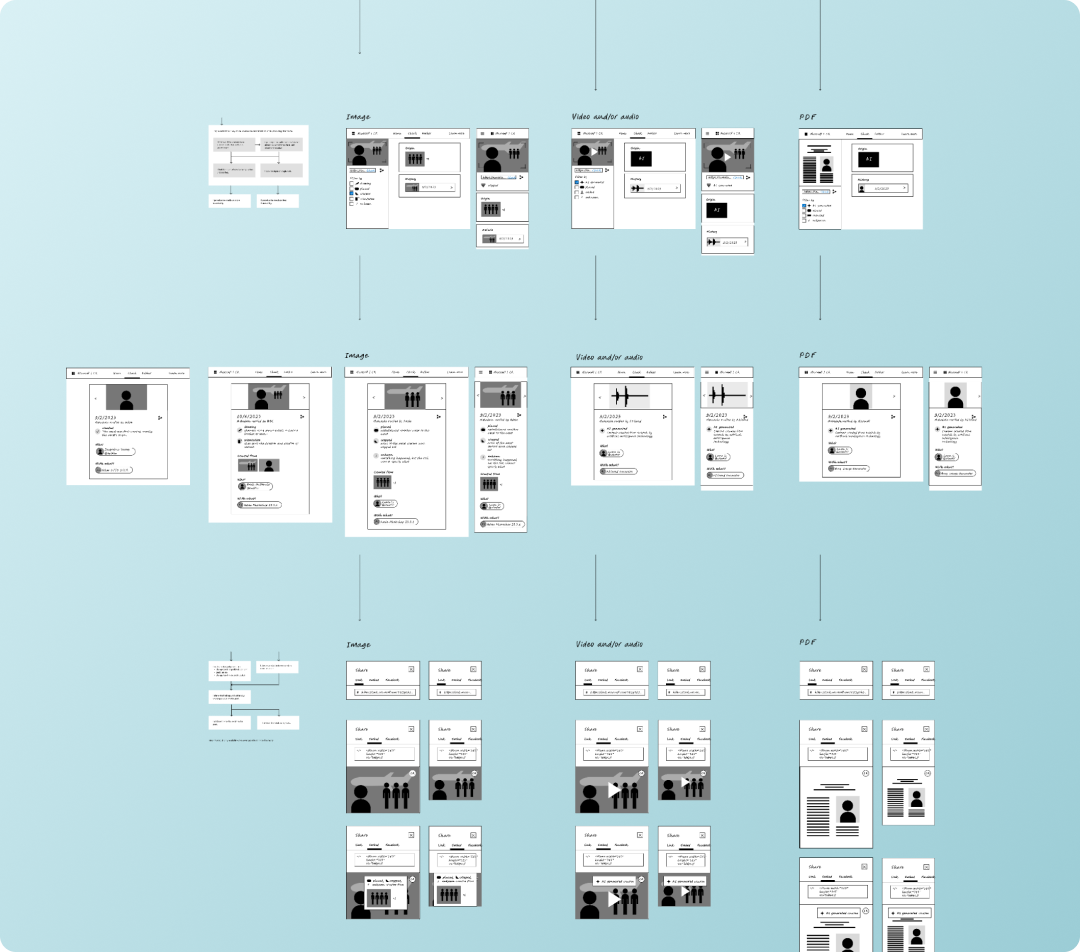
Adversarial journey mapping exposed where incomplete credentials or bad actors could distort trust.
Leadership mandate
I set the vision and UX strategy for content authenticity at Microsoft, with accountability spanning product experience, governance, and industry collaboration.
I managed a five-person UX team: a principal designer, an early-career designer, two UX researchers, and a content designer. We partnered with 10 PMs distributed across organizations and geographies, while dozens of developers implemented experiences based on our designs.
My responsibilities included:
- Defining a coherent UX model for trust and uncertainty
- Leading and staffing a multidisciplinary design, research, and content team
- Influencing planning across PM organizations and aligning engineering, Legal (CELA), and Responsible AI partners
- Representing Microsoft in cross-company C2PA UX collaboration
- Translating research into shipped experiences and reusable review criteria
My role was to turn competing technical, legal, and user needs into decisions that individual product teams could apply consistently.
Strategic decision
From “Verified” to “Certified”
During industry collaboration, I challenged the proposed “Verified” terminology. Research and partner reviews showed that people could interpret it as a declaration that the content itself was authentic or true, creating both trust and legal risk. As the UX leader accountable for the model, I made the final terminology decision.
I recommended “Certified” as a more precise foundation. In this system, certification means that a provenance record is present and its integrity can be evaluated. It does not certify that the depicted event happened, that every claim is accurate, or that Microsoft endorses the content.
- Before: “Verified” — People could interpret the label as fact-checking or Microsoft endorsement.
- After: “Certified” — The label described an authenticated provenance record while preserving the user’s role in judging the content.
This reframing preserved neutrality while giving people useful evidence. It was adopted across Microsoft products and codified into shared UX patterns, replacing ad-hoc labels with a common decision model.
System design
We designed the experience as a journey. When someone encountered an image, the first layer provided a concise provenance state. Opening the panel revealed origin, edit history, and AI involvement. Deeper inspection exposed credential details without forcing technical complexity into the primary experience.
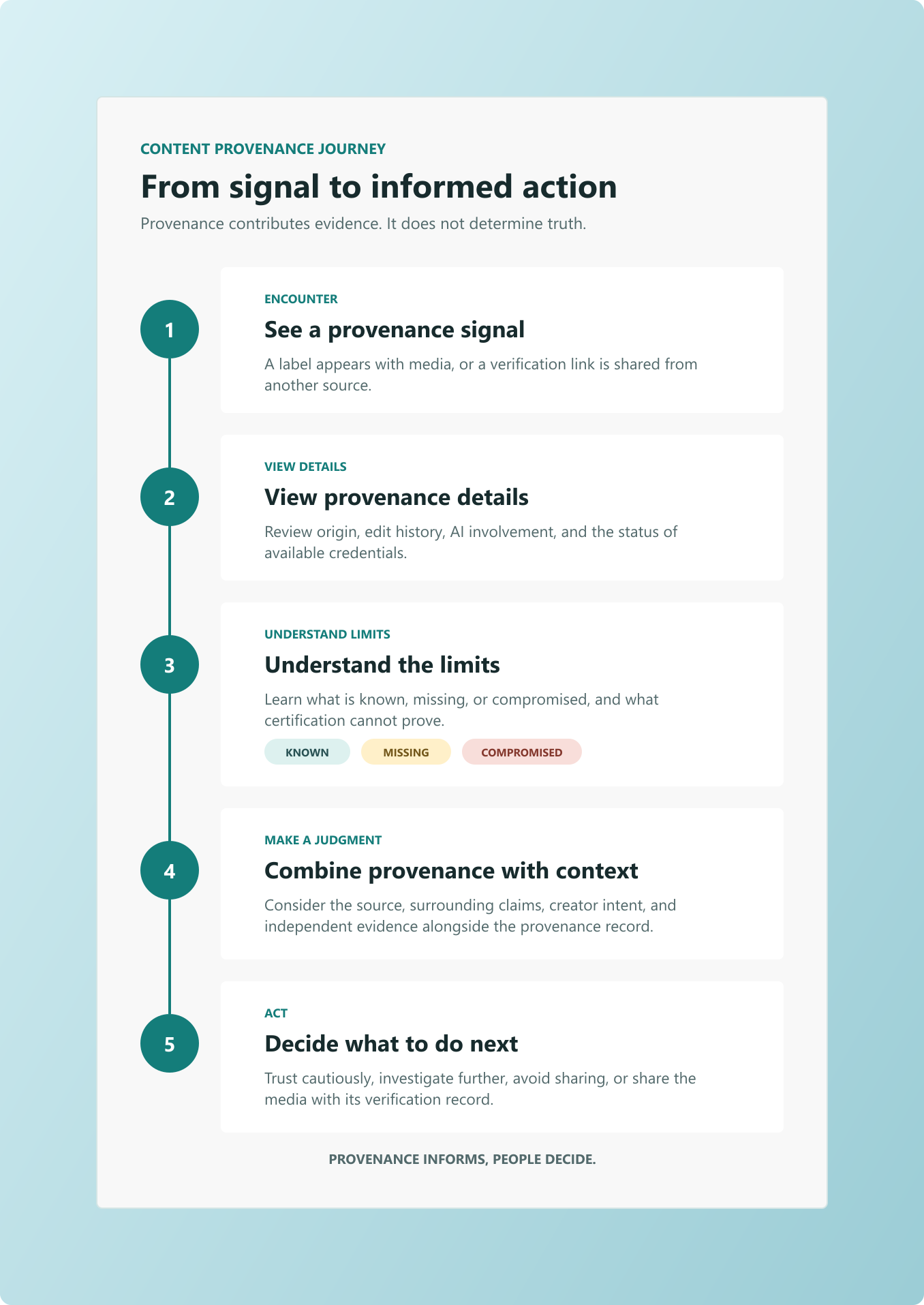
Research showed that provenance should support people’s judgment while leaving the final assessment to them. Users needed a clear path from encountering a signal, to understanding its limits, to deciding what to do next.
Shared trust states
- Certified — A provenance record is present and its integrity can be evaluated
- Known History — Some origin or edit information is available
- Incomplete — Parts of the provenance chain are missing
- Tampered — The credential or recorded history shows signs of compromise
Each state explained what was known, what was missing, and how to interpret the signal without asserting truth or endorsement.
Certification does not mean the content is true. It means the provenance record can be authenticated.
Design principles
- Clarity without endorsement — Inform without implying approval
- Progressive disclosure — Surface essentials first and deepen on demand
- Resilience to uncertainty — Make incomplete and tampered states legible
- Accessibility by default — Use non-color cues, plain language, and assistive-technology-friendly ordering
Verification portal
For high-risk scenarios such as election workflows, we created a neutral upload-and-check experience framed as “Certification, not endorsement.”
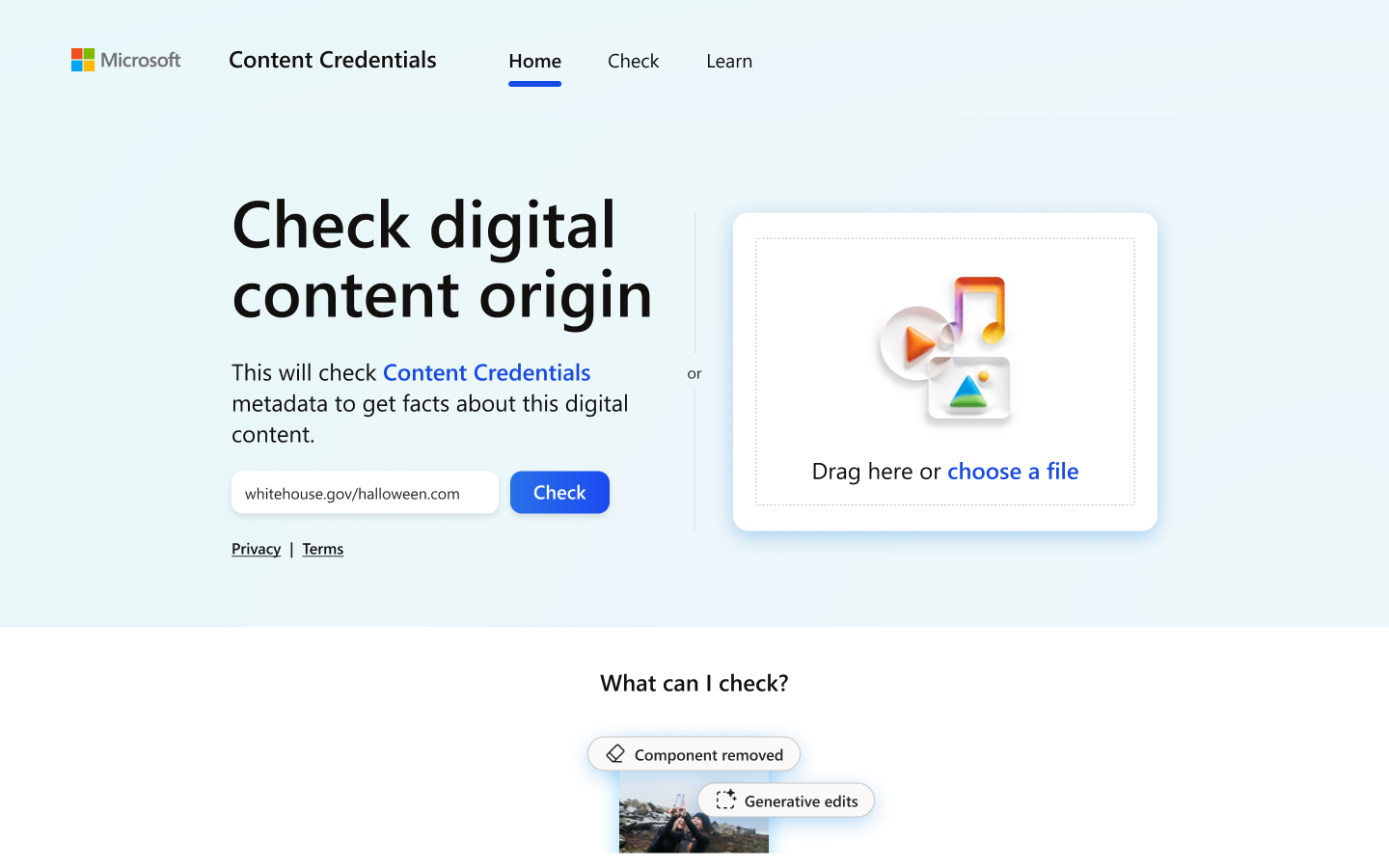
The verification portal translated complex credential data into a clear, neutral explanation of media history.
Validation
We treated trust as a design outcome to investigate and validate, not an opinion.
Evidence across three studies
Three iterative studies with 22 participants total examined how people understood provenance information and how different labels, disclosures, and credential states affected trust:
- An exploratory study with 8 participants examined provenance watermarking and trust in generative AI images
- Two rounds of verification-site usability testing included 4 low-fidelity and 4 high-fidelity participants
- A comprehension study with 6 participants tested terminology and the Content Integrity experience
What the research changed
Across the studies, we refined terminology, sequencing, disclosure depth, and failure-state guidance.
- Participants confused “Verified” with fact-checking, endorsement, and paid social-media verification; the later comprehension study recommended “Certified” instead
- A clear non-endorsement disclaimer reduced suspicion about Microsoft’s role
- Plain language and pairing “metadata” with “Content Credentials” improved comprehension
- Progressive disclosure helped people access useful history without overwhelming the primary experience
- Incomplete, suspicious, and missing credentials were difficult to interpret and needed explicit contextual guidance
- Transparency could create misplaced trust when people interpreted disclosure itself as evidence that a source was credible
Iterative studies connected terminology, disclosure depth, and failure-state guidance to concrete design decisions.
We refined the trust model through three studies, then tested it in real-world pilots, including election workflows where it had to remain useful under incomplete data, adversarial behavior, and operational constraints.
Adoption & influence
This initiative was measured as trust infrastructure and risk reduction, not engagement.
Adoption took time. Content provenance was still a nascent space, and we were asking teams to invest in designs for a user need many had not yet recognized. The central challenge was building conviction across independently planned product organizations, well beyond the specification handoff.
I influenced those planning conversations by pairing our design direction with research evidence and cross-referencing it against C2PA guidance. That gave teams both user validation and an external standard against which to evaluate the work. Over time, the product organizations adopted the designs my team created under my guidance, and dozens of developers built against the shared model.
Product adoption
- Shipped provenance experiences across Bing, Designer, Edge, and LinkedIn
- Recorded 5,000+ verification events through the portal in its first month
- Established reusable patterns for image creation, editing, browsing, and professional networks

Bing Images applied the shared provenance model at the point where people encountered and evaluated media.
Enduring influence
- Integrated authenticity checks into AI quality and review processes
- Contributed to industry UX guidance through C2PA collaboration
- Informed policy and cross-sector discussions about content authenticity
- Moved Microsoft from ad-hoc labeling toward a systemic, neutral trust model
Leadership lessons
- Define the boundary of the promise. Trust grows when a system states precisely what it can and cannot prove.
- Treat language as product architecture. One terminology decision can align legal risk, user understanding, and cross-product consistency.
- Design failure states with the primary experience. Incomplete and compromised credentials are part of the system, not edge cases.
- Build decisions that travel. Shared principles and states allowed teams to adapt the model without fragmenting it.
This work reflects how I lead ambiguous, high-risk initiatives: establish a defensible point of view, align partners around clear decisions, and build systems that scale beyond a single product.
Tags